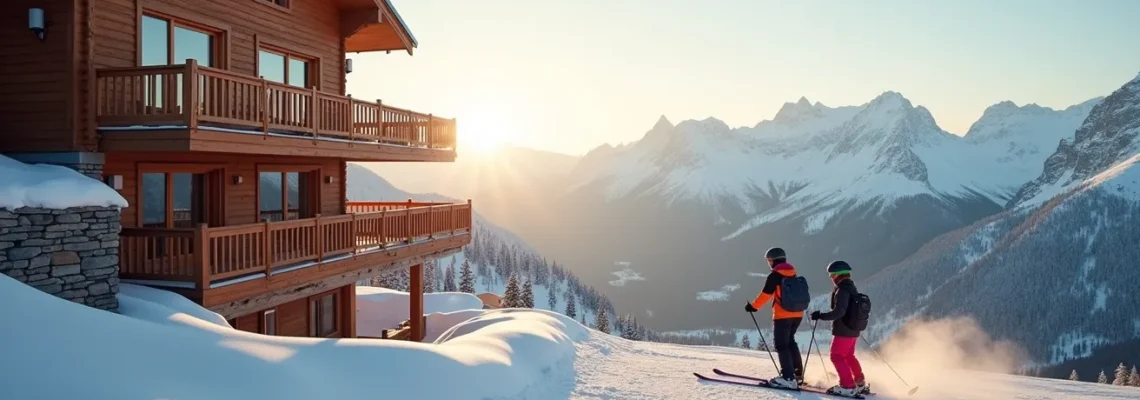
Courchevel’s premium reputation comes with premium price tags. When browsing accommodation options, the 20-30% surcharge for ski-in ski-out properties raises an inevitable question: does direct slope access truly justify the investment, or is it merely an overpriced convenience?
The answer transforms when you shift from emotional justification to economic analysis. Ski-in ski-out isn’t simply about comfort—it’s a strategic vacation optimizer that fundamentally alters how you extract value from limited alpine time. For travelers considering Courchevel holiday rental and real estate options, understanding the quantifiable return extends far beyond avoiding a shuttle ride.
From quantifying real economic value to revealing hidden benefits, this analysis builds a complete decision framework. The goal: transform ski-in ski-out from a simple convenience label into a measurable investment that either multiplies your vacation quality—or exposes when that premium delivers diminishing returns.
Ski-In Ski-Out Value in 4 Key Metrics
- Direct slope access eliminates 2-3 hours daily in transport and transitions, translating to 15-25% more actual skiing time
- Premium pricing (20-30% above standard) delivers 40% more effective ski time when vacation hours are properly valued
- Hidden benefits extend beyond skiers—flexibility advantages transform the experience for entire travel groups including non-skiers
- ROI multiplies exponentially on short stays: 3-day trips recover 20%+ of total vacation time versus 8% on week-long visits
The Real Economics of Ski-In Ski-Out in Courchevel
The conventional marketing pitch claims ski-in ski-out “saves time” and “adds convenience.” These vague promises sidestep the critical question: exactly how much time, and what is that time actually worth when measured against your total vacation investment?
Start with the baseline calculation. A typical alpine day involves multiple transitions: morning equipment retrieval, transport to slopes, base area navigation, and reverse logistics at day’s end. Conservative estimates place this overhead at 90-120 minutes minimum. For properties requiring shuttle coordination or significant walking with gear, the number climbs to 150-180 minutes daily.
Eliminating these transitions creates measurable skiing gains. Based on average run times in Courchevel’s terrain, 2-3 recovered hours translate to 3-5 additional runs per day—representing a ski-in ski-out lodging market growing 12% annually as travelers recognize this quantifiable advantage. Over a week-long stay, that’s 21-35 extra runs, or roughly 15-25% more actual skiing.
The vacation time valorization methodology provides the second crucial metric. If your total trip costs €5,000 for a family across accommodation, flights, passes, and meals, each vacation hour carries an implicit value. Dividing total investment by available hours (typically 7 days × 16 waking hours = 112 hours) yields approximately €45 per hour. Wasting 2.5 hours daily in logistics means burning €112.50 in vacation value—every single day.
Economic Impact Analysis of Western Canadian Ski Areas 2022-23
The 2022/23 season demonstrated substantial economic growth in ski resorts, with $2.73 billion generated across Western Canada—a 32% increase from the previous season. The study revealed that ski areas contribute significantly to local economies, with British Columbia generating $2.15 billion and Alberta $505 million in economic impact, showcasing the premium value visitors place on mountain access. This data underscores why properties with superior slope connectivity command sustained price premiums: guests demonstrate willingness to pay for proximity that maximizes their mountain investment.
Opportunity cost analysis extends beyond pure time waste. Shuttle schedules impose rigid departure windows, forcing groups to synchronize around the least common denominator. Carrying ski equipment through hallways, lobbies, and parking areas introduces physical fatigue before skiing even begins. Coordination overhead—waiting for stragglers, managing locker logistics, navigating crowded base areas—adds invisible stress that compounds throughout the week.
The premium price justification emerges clearly when framing these numbers correctly. A 25% accommodation surcharge delivering 40% more effective skiing represents exceptional return for time-constrained travelers. The critical threshold: does your vacation time have quantifiable value, and does eliminating waste justify the incremental cost?
| Pass Type | Cost per Day | Break-even Point | Best For |
|---|---|---|---|
| Single Day Ticket | $299 (peak) | N/A | 1-2 day trips |
| Multi-day Pass | $100/day | 3+ days | Week-long stays |
| Epic Pass | $50-85/day | 10+ days | Multiple trips |
Understanding pass economics clarifies why time optimization matters intensely in Courchevel’s premium market. When daily lift access costs €70+ and accommodation baselines start high, every wasted hour carries amplified expense. Ski-in ski-out transforms from luxury amenity into strategic asset.
ROI Calculation Framework for Ski-In Ski-Out Premium
- Calculate total vacation hours (typically 7 days × 8 skiing hours = 56 hours)
- Multiply saved transit time by trip days (2-3 hours daily × 7 days = 14-21 hours recovered)
- Divide total trip cost by hours to get hourly vacation value
- Compare 20-30% accommodation premium against 25-40% more effective ski time gained
The Hidden Value Beyond Maximized Ski Time
Quantified metrics capture ski-in ski-out’s tangible benefits, yet the complete value proposition extends into quality-of-life improvements that resist easy measurement. These invisible advantages often matter most for the forgotten constituency in most ski accommodation analysis: the non-skiers, occasional skiers, and flexibility-seekers traveling in mixed groups.
The spontaneity factor represents perhaps the most underrated benefit. Weather shifts unpredictably in alpine environments—morning fog, afternoon whiteout, or that perfect two-hour window of sunshine. Ski-in ski-out enables instant adaptation. Return for lunch when winds pick up. Swap equipment when conditions change from powder to ice. Take a 90-minute midday break and return refreshed for golden-hour runs.
Remote accommodations eliminate this flexibility entirely. Once you’ve committed to the morning shuttle and deposited gear in base lockers, you’re locked into a full-day commitment regardless of conditions, energy levels, or evolving preferences. The mental rigidity compounds daily, particularly on week-long trips where accumulated fatigue makes afternoon flexibility increasingly valuable.
Families discover the spontaneity advantage during unpredictable moments that define memorable vacations. The impromptu hot chocolate break on a sun-drenched terrace becomes possible when home sits 90 seconds away, creating organic family time impossible when chained to shuttle schedules and distant lodging.

Multi-profile group dynamics reveal ski-in ski-out’s democratizing effect. In standard accommodations, the non-skier spouse endures pressure to “make the commute worthwhile” by staying out longer than desired. The intermediate skier feels obligated to match the group’s pace because coordinating separate return times creates logistical headaches. Children’s fluctuating energy levels force entire families into lowest-common-denominator schedules.
Direct slope access eliminates these coordination taxes. Non-skiers confidently split their day, knowing they can easily rejoin the group. Varying ability levels coexist harmoniously—strong skiers maximize vertical, while others rest and rotate back independently. This autonomy reduces invisible friction, transforming group dynamics from managed obligation into genuine shared enjoyment where individual preferences don’t burden the collective.
Stress elimination delivers quantifiable health benefits that justify premium pricing through a different lens. Zero shuttle timing anxiety. No gear portage through crowded spaces. Eliminated group synchronization overhead. The mental load reduction might seem trivial when described, yet cumulative stress relief throughout a week materially improves vacation satisfaction beyond what ROI calculations capture.
Micro-recovery opportunities emerge as the performance-adjacent benefit. Strategic 30-minute warm-up breaks prevent the cumulative fatigue that degrades technique and safety. Layer changes in response to shifting temperatures become effortless rather than a complex gear-locker expedition. These granular optimizations compound over days, enabling sustained high-quality skiing that remote accommodations simply cannot match.
The Performance Advantages of Instant Slope Access
Beyond adding quantity through extra runs, ski-in ski-out fundamentally improves skiing quality. The connection between energy preservation, technical performance, and safety creates a compounding advantage that intensifies as trips progress and fatigue accumulates.
Energy preservation translates directly into better technique. Fresh legs maintain proper form—hips forward, ankles flexed, upper body quiet. Fatigued legs default to defensive positions that reduce control and increase injury risk. Afternoon accidents occur significantly more frequently than morning incidents precisely because cumulative exhaustion degrades decision-making and muscle response.
The visual perspective shift reveals untapped potential in pristine morning conditions, where undisturbed slopes offer optimal performance opportunities for those positioned to capture them efficiently.

Eliminating pre-ski commute stress preserves this morning energy advantage. Travelers in remote properties start each day with 45-90 minutes of equipment handling, shuttle timing pressure, and base area navigation. Even before the first run, they’ve burned physical and mental energy. Ski-in ski-out guests step directly onto uncrowded slopes with full reserves, creating a meaningful performance delta from the very first turn.
First-tracks strategic advantage extends beyond bragging rights. Courchevel’s high-demand terrain experiences significant traffic, particularly on powder days when early conditions deteriorate rapidly. Accessing slopes at opening bell without pre-commute logistics means capturing pristine snow before crowds arrive—especially valuable in sought-after zones where line formation begins within 30 minutes of lifts starting.
Tactical timing flexibility unlocks another performance layer. Ski optimal windows: post-grooming corduroy, between crowd waves, best light conditions, strategic lunch timing to avoid peak queues. Shuttle-dependent properties lock travelers into rigid schedules dictated by transport availability rather than mountain conditions. This inflexibility means skiing when slopes are crowded and conditions mediocre, rather than orchestrating days around quality windows.
Active recovery capability creates the unique advantage of tactical retreat and return. Feeling heavy legs after morning runs? Take a genuine 30-minute break at home, refuel properly, and return refreshed rather than pushing through degraded performance. Remote accommodations impose a binary choice: full day out regardless of how you feel, or end skiing entirely because return logistics are prohibitively complex.
The cumulative effect compounds throughout the week. Day one’s energy advantage enables better skiing, which reduces fatigue, which enables day two’s better performance, creating an upward spiral. Remote properties experience the inverse: day one’s extra fatigue degrades day two’s skiing, compounding throughout the trip into a downward performance trajectory that ends with survival skiing rather than enjoyment.
The Amplified Returns on Short Alpine Getaways
Ski-in ski-out value isn’t uniform across all trip durations. The return multiplies exponentially on compressed timeframes where every hour represents a larger percentage of total vacation—revealing why short-stay travelers experience disproportionate benefits that justify premium pricing more compellingly than week-long visitors.
The ratio optimization mathematics proves this conclusively. On a 3-day ski trip, eliminating 2.5 hours daily in transport and transitions recovers 7.5 hours total. With approximately 36 available skiing hours (3 days × 12 hours mountain access), that 7.5-hour recovery represents 20.8% of total vacation time. The same 2.5-hour daily savings on a 7-day trip recovers 17.5 hours from 84 available (20.8% as well), but the perception shifts because absolute days feel more abundant.
Cumulative waste calculations expose where time evaporates on short trips. Transport (shuttle wait + travel), coordination (group synchronization), gear handling (locker logistics + equipment portage), and base area navigation compound into 2.5-3 hours daily. Across a 3-day weekend, that’s 7.5-9 hours lost—equivalent to an entire additional ski day. The shorter the trip, the more painful each wasted hour becomes.
Strategic equipment management enables optimized transitions during brief but critical windows when conditions and body alignment coincide perfectly.

Courchevel’s premium context amplifies the short-stay ROI argument. High lift pass costs—often €70+ daily—make every wasted hour disproportionately expensive. When accommodation baselines already start elevated regardless of proximity, the incremental 25% ski-in ski-out surcharge represents smaller relative increase. For a 3-day trip where passes alone cost €210+ per person, optimizing time utilization becomes paramount.
Arrival and departure day value capture delivers the final multiplier for short stays. Week-long travelers often write off travel days as lost skiing time. Three-day weekenders cannot afford that luxury. Ski-in ski-out enables productive half-day skiing on both bookend days—arriving Friday afternoon and catching 2-3 hours before sunset, departing Sunday with a full morning session before checkout. This effectively adds an entire extra day to compressed trips, transforming a “3-day weekend” into genuine 4-day skiing value.
The comparison becomes stark: a 3-day remote property trip might yield 18-20 hours of actual slope time after subtracting logistics overhead. The equivalent ski-in ski-out trip delivers 26-28 hours—a 40% increase in effective skiing from identical calendar allocation. For time-constrained professionals maximizing limited vacation days, this multiplier effect justifies substantial premiums.
Properties in nearby resorts like Meribel Mottaret apartments demonstrate similar proximity advantages within the broader Trois Vallées system, offering travelers options to optimize location against budget constraints while maintaining strategic slope access.
Key Takeaways
- Ski-in ski-out delivers 15-25% more skiing time by eliminating 2-3 hours daily logistics overhead
- Premium pricing of 20-30% becomes justified when vacation time is properly valorized against total trip investment
- Hidden benefits extend to non-skiers and mixed groups through flexibility, spontaneity, and stress elimination
- Short 3-5 day trips experience exponential ROI as time savings represent larger percentage of total vacation hours
- Honest assessment reveals optimal profiles versus scenarios where alternatives suffice
The Honest Verdict: Who Benefits Most from Ski-In Ski-Out
Resisting universal advocacy builds credibility. Ski-in ski-out isn’t optimal for everyone, and acknowledging this truth helps travelers make informed decisions aligned with their specific profiles rather than aspirational marketing claims.
Optimal benefit profiles emerge clearly from the economic and quality-of-life analysis. Families with young children gain disproportionate value—gear management complexity, unpredictable energy levels, and frequent transition needs make direct slope access transformative rather than merely convenient. The ability to return home for naps, equipment swaps, or meal flexibility eliminates the logistical nightmare that defines young-family ski trips in remote properties.
Mixed-ability groups represent the second high-value category. When travel parties include non-skiers, occasional skiers, and varying skill levels, the flexibility to operate independently without coordination overhead transforms group dynamics. Everyone optimizes their own experience without burdening others, creating harmonious vacations impossible under rigid shuttle-dependent logistics.
Short-stay visitors (3-5 days) receive maximum ROI as demonstrated in the previous section. Time-constrained professionals maximizing limited vacation days cannot afford to waste 20% of available hours on logistics. The premium pays for itself through multiplicative time recovery that effectively adds an entire extra day to compressed trips.
Convenience-over-cost prioritizers—those valuing stress elimination and flexibility above budget optimization—find ski-in ski-out aligns perfectly with their decision criteria. If vacation quality matters more than incremental savings, direct slope access delivers tangible quality-of-life improvements worth substantial premiums.
Lower-priority scenarios deserve equal honesty. Experienced solo skiers pursuing backcountry objectives often leave pre-dawn anyway, negating slope-proximity advantages. Their gear is streamlined, coordination overhead is zero, and they’re specifically seeking terrain beyond immediate resort boundaries. For this profile, ski-in ski-out delivers minimal incremental value.
Week-plus stays with relaxed pace experience reduced time pressure. When you have 10-14 days, losing 2 hours daily to logistics represents smaller percentage of total vacation. The urgency that drives short-trip optimization evaporates, making shuttle-based properties perfectly adequate for travelers prioritizing cost savings over marginal convenience gains.
Budget-conscious travelers willing to trade convenience for savings make rational choices selecting well-located non-ski-in-ski-out properties. If your total trip budget is constrained and the 25% accommodation premium strains finances, shuttle-based lodging delivers 85% of the skiing experience at significantly reduced cost. The value equation shifts when budget limitations override optimization preferences.
For travelers exploring options beyond Courchevel’s premium tier, alternatives like Discover Meribel Village options provide strategic access to the Trois Vallées system with different cost-benefit profiles worth evaluating against specific trip parameters.
The personalized decision framework requires calculating your specific variables: (group size × trip days × daily time value × energy/convenience priority weight) compared against absolute premium cost. This formula yields rational decisions rather than aspirational purchases that disappoint when reality doesn’t match marketing promises.
Alternative considerations demand attention to detail. “Ski-nearby” isn’t equivalent to true “ski-in ski-out”—verify whether “slope access” means genuinely stepping onto runs, or whether it requires 5-minute walks that reintroduce coordination and gear-portage friction. Evaluate shuttle quality and frequency for alternative properties—frequent, reliable shuttles dramatically reduce remote-property disadvantages compared to sporadic, unreliable service.
Understanding the trade-off spectrum reveals that accommodation decisions exist on a continuum rather than binary choice. Truly ski-in ski-out commands maximum premiums but delivers maximum value. Ski-nearby properties offer 80% of benefits at 15% premiums. Well-serviced shuttle properties provide 70% of value at baseline pricing. Match your profile to the appropriate point on this spectrum rather than defaulting to either extreme.
Frequently Asked Questions About Ski-In Ski-Out
How much premium should I expect to pay for ski-in ski-out in Courchevel?
Typically 20-30% above comparable standard accommodations, though this varies by specific property and season. This premium delivers approximately 40% more effective ski time through eliminated transport and transition overhead, representing strong ROI when vacation time is properly valued against total trip investment.
What about mixed-ability groups with non-skiers?
Ski-in ski-out is particularly valuable for mixed groups, enabling everyone to ski at their own pace and return independently throughout the day. Non-skiers can easily split time between slopes and other activities without forcing coordination, while varying ability levels coexist without the pressure to synchronize around rigid shuttle schedules.
Does ski-in ski-out value differ between short and long trips?
Yes, dramatically. Short 3-5 day trips experience exponential ROI because eliminating 2-3 hours daily represents 20%+ of total vacation time. Week-long or longer stays see reduced relative benefit as time pressure diminishes, making the premium less compelling for relaxed-pace extended vacations.
How can I verify if a property is truly ski-in ski-out versus just ski-nearby?
Confirm whether slope access means stepping directly onto runs from the property, or if it requires walking with gear for several minutes. True ski-in ski-out allows you to click into bindings at your door and ski to lifts immediately. Properties requiring 5+ minute walks reintroduce much of the coordination and gear-portage friction that erodes the core value proposition.