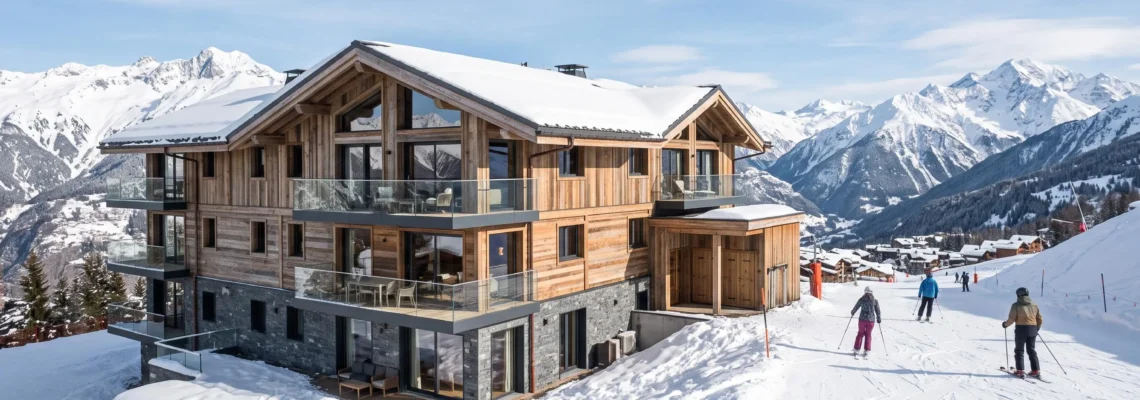
Courchevel ski-in/ski-out properties attract investors with promises of premium rental income and capital preservation in one of the world’s most prestigious resorts. Yet the gap between agent-quoted gross yields and actual net returns remains one of the sector’s least transparent issues. Direct piste access commands a legitimate premium—typically 20–40% above equivalent village-centre properties—driven by genuine scarcity and superior rental appeal. The critical question centres not on whether the premium exists, but whether it translates into proportional returns once management fees, co-ownership charges, taxes and void periods erode the headline figures.
The challenge facing international investors, particularly UK-based buyers evaluating alpine diversification, lies in reconciling Courchevel’s undeniable market strengths—global brand recognition, structural supply constraints, ultra-high-net-worth demand resilience—with the full economic reality of ownership. Gross rental yields of 5–7% frequently cited in marketing materials can settle at 2.5–4% net once the complete cost stack is deducted, making transparent analysis essential before committing capital.
This article provides general market analysis of Courchevel property investment fundamentals based on available data. It does not constitute personalised financial, tax or legal advice. Property investment involves significant capital commitment and risk. French tax and legal obligations for non-resident buyers are complex and subject to change. Readers must consult qualified cross-border tax advisors, French property lawyers and independent financial advisors before making investment decisions.
- Why ski-in/ski-out properties in the 3 Vallées command a premium
- Rental yield expectations: what returns can investors realistically target?
- Capital appreciation trends in Courchevel’s property market
- Which Courchevel village offers the best investment fundamentals?
- Hidden costs and operational realities of alpine property ownership
- Tax implications and legal considerations for international buyers
- Frequently asked questions
- Making the investment decision with transparent expectations
Why ski-in/ski-out properties in the 3 Vallées command a premium
True ski-in/ski-out access represents a structural scarcity in Courchevel. Planning restrictions and topographic constraints mean only a limited percentage of the resort’s housing stock offers genuine direct piste access, where residents can exit their building and immediately access ski runs without shuttle transfers or walking. This scarcity creates the foundation for premium pricing, distinguishing these properties from those marketed as “ski-in/ski-out” but requiring short walks or free shuttle rides.
The tangible benefit extends beyond prestige. Eliminating transfer time adds one to two hours of actual skiing daily for families, a material advantage over a week-long holiday. For rental guests paying premium weekly rates, this convenience factor drives booking decisions. Properties with authentic slope access typically command 15–25% higher weekly rental rates and achieve superior occupancy compared to equivalent specifications located five to ten minutes’ walk from lifts.
Courchevel’s position within Les Trois Vallées—the world’s largest linked ski area—amplifies the scarcity premium. The resort attracts global demand from ultra-high-net-worth individuals seeking both personal use and investment returns, creating deeper buyer pools than smaller independent resorts. Agencies such as Altitude Courchevel Estate Agents specialising in the local market report that ski-in/ski-out inventory remains the most sought-after segment, with limited new supply due to development restrictions protecting the alpine environment.
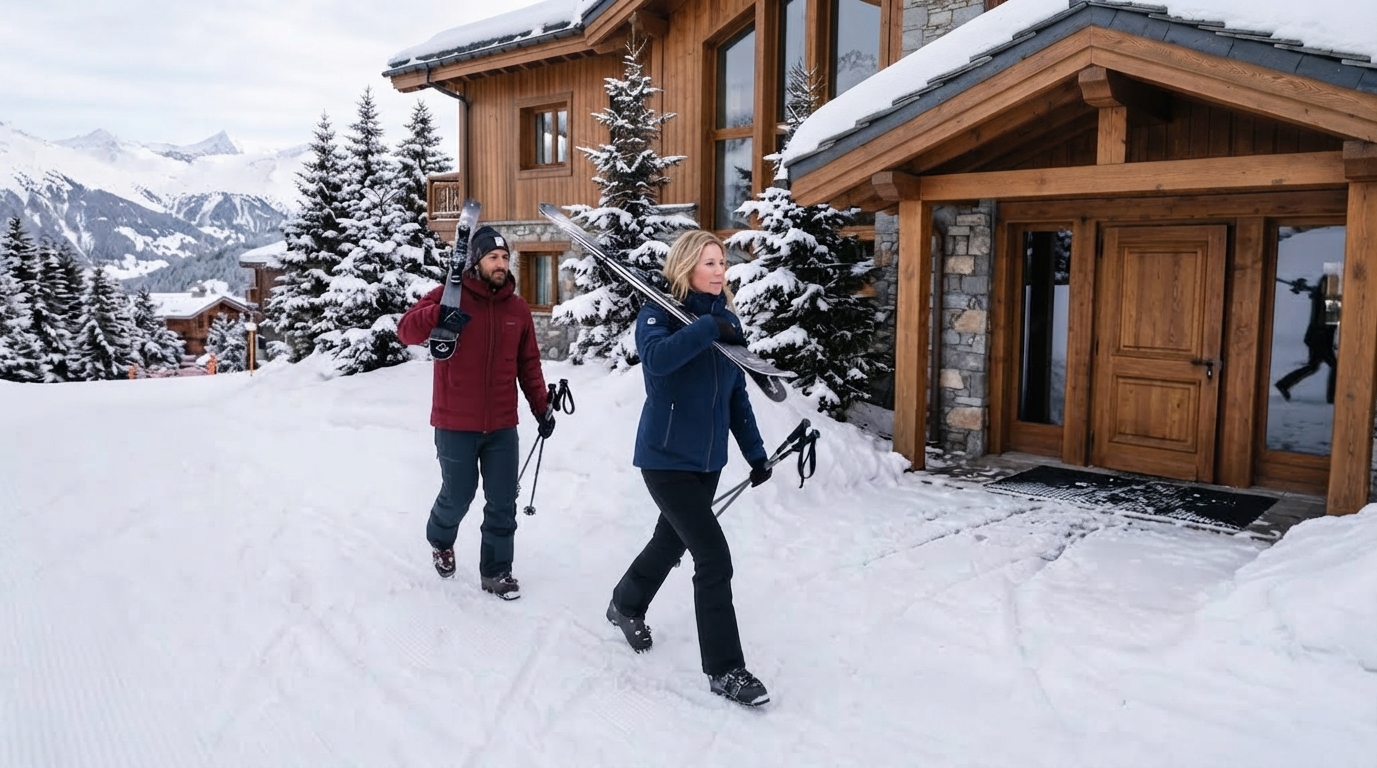
The premium per square metre varies by village and property specification, but buyers should anticipate paying 20–40% more for ski-in/ski-out access compared to similar-quality apartments requiring short walks to slopes. Whether this premium delivers proportional investment returns depends critically on accurate yield projections and transparent cost accounting.
Rental yield expectations: what returns can investors realistically target?
Gross rental income calculations begin with weekly rates multiplied by achievable occupancy. Well-positioned ski-in/ski-out properties in Courchevel 1850 typically command €3,500–€5,500 per week for a two-bedroom apartment during peak winter season, with shoulder weeks generating lower rates. A professionally managed property achieving strong performance might secure 18–22 weeks of occupancy annually across winter and summer seasons, though this represents solid performance rather than a guaranteed baseline.
The cascade from gross to net yield reveals where returns erode. Property management companies typically charge 20–25% of gross rental income, covering marketing, guest services, cleaning, linen provision, maintenance coordination and regulatory compliance. This represents the largest single deduction and is rarely optional for non-resident owners managing properties remotely from the UK or elsewhere.
A worked example illustrates the full cost structure. Consider a €1.5 million two-bedroom ski-in/ski-out apartment in Courchevel 1850 achieving 20 weeks’ occupancy at an average €4,500 per week. Gross rental income totals €90,000. Deducting 22% management fees (€19,800) leaves €70,200. Annual charges de copropriété for a building with lift, spa and concierge services might reach €8,000. Taxe foncière adds approximately €2,500. After these operating costs, taxable rental income stands at €59,700.
Tax obligations further reduce returns. Non-resident landlords face French income tax on rental profits plus social charges. According to impots.gouv.fr, social charges on rental income from French sources apply at 17.2%, though UK residents benefit from partial exemption, paying only the 7.5% solidarity levy due to ongoing social security coordination despite Brexit. Combined income tax and social charges might total €15,000–€18,000 depending on individual tax positions, leaving net annual income of approximately €42,000–€45,000. This represents a net yield of 2.8–3.0% on the €1.5 million purchase price.
Net Yield Reality Check: Industry-standard net yields for well-managed Courchevel ski-in/ski-out properties typically settle at 2.5–4% after all deductions, significantly below the 5–7% gross figures often quoted in initial marketing. The gap between gross and net returns widens further for properties in buildings with extensive amenities driving higher co-ownership charges.
| Item | Amount (€) | Note |
|---|---|---|
| Gross rental income | 90,000 | 20 weeks × €4,500 average |
| Management fees (22%) | −19,800 | Industry standard 20–25% |
| Charges de copropriété | −8,000 | Building with amenities |
| Taxe foncière | −2,500 | Annual property tax |
| Taxable income | 59,700 | Before income tax |
| Tax + social charges | −15,000 | Indicative for UK non-resident |
| Net annual income | 44,700 | Net yield: 3.0% |
Occupancy rate sensitivity materially affects outcomes. Properties achieving only 15 weeks annually see gross income fall to €67,500, reducing net yields closer to 2%. Conversely, exceptional properties securing 24 weeks might reach 3.5–4% net, though sustained occupancy at this level requires prime location, impeccable presentation and responsive management.
Capital appreciation trends in Courchevel’s property market
Long-term capital appreciation represents the second component of total return for alpine property investors. According to the FNAIM study on ski resort property markets, Courchevel averaged €13,637 per square metre as of 1 October 2025, positioning it as France’s second-most expensive ski resort behind Val d’Isère.
The decade following the 2008 financial crisis showed relative price stagnation in luxury alpine markets, with Courchevel experiencing flat to modest growth through 2012. Recovery accelerated from 2015 onwards, driven by ultra-high-net-worth demand from UK, Middle Eastern and Asian buyers. The post-Covid period proved particularly strong, with prices rising 27% between July 2020 and April 2023 as wealthy individuals prioritised private alpine retreats offering space and outdoor access. Following brief stabilisation, the market resumed appreciation with 3.5% growth in the six months preceding the October 2025 FNAIM data.
27%
price increase
Courchevel property appreciation between July 2020 and April 2023, followed by continued growth of 3.5% in the subsequent six months (FNAIM, October 2025 data)
Demand drivers underpinning appreciation include structural supply scarcity, with planning restrictions limiting new development to protect the alpine environment and preserve ski domain access. Courchevel’s global brand recognition ensures deep international buyer pools less dependent on single-market demand than smaller resorts. The resort’s position within Les Trois Vallées provides skiing security even as climate concerns affect lower-altitude destinations, supporting long-term value resilience.
Investors should recognise that historical appreciation does not guarantee future performance. Markets experience cycles, and the 2008–2012 period demonstrates that even prestigious resorts face stagnation during broader economic downturns. Liquidity constraints also matter—selling a €2 million+ ski-in/ski-out property typically requires 6–18 months in normal conditions, with timelines extending during market softness. Those requiring exit flexibility within five to seven years must factor potential market timing risk into investment decisions.
Which Courchevel village offers the best investment fundamentals?
Courchevel comprises five interconnected villages at different altitudes, each offering distinct price points, rental markets and risk-return profiles. The FNAIM figure of €13,637 per square metre represents a resort-wide average, masking significant village-level variation that materially affects investment fundamentals.
Courchevel 1850 commands the highest prices, with ski-in/ski-out properties frequently exceeding €15,000–€25,000 per square metre depending on exact location and specification. The village attracts ultra-high-net-worth buyers prioritising brand prestige, capital preservation and global recognition. Rental demand centres on affluent international guests seeking Courchevel’s most exclusive address, supporting premium weekly rates but also higher occupancy volatility during economic uncertainty. Liquidity remains strongest in 1850, with the deepest resale market, though entry capital requirements of €2 million+ for quality ski-in/ski-out apartments limit buyer pools.
Courchevel 1650 (Moriond) offers a mid-premium positioning, balancing yield potential with appreciation prospects. Prices typically range €10,000–€16,000 per square metre for ski-in/ski-out access. The village attracts affluent families seeking excellent skiing and village amenities without the ultra-premium price tag, creating robust rental demand from yield-focused owners. Properties in this segment often deliver the strongest risk-adjusted returns, combining respectable net yields (approaching 3–4% for well-managed units) with steady capital appreciation linked to Courchevel’s overall brand strength.
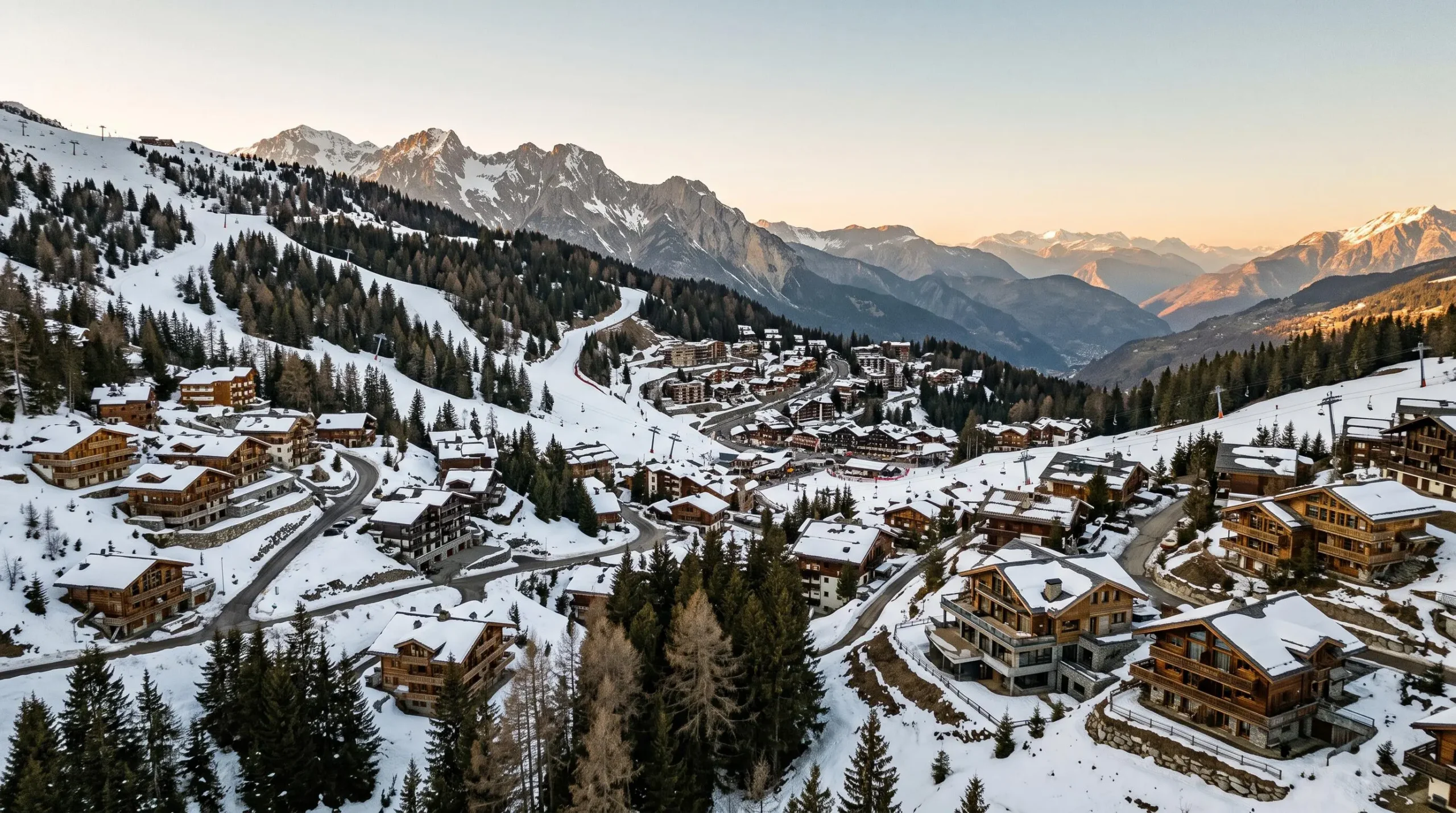
Courchevel 1550 and 1350 (Le Praz) provide more accessible entry points, with ski-in/ski-out properties starting from €7,000–€12,000 per square metre. These villages attract value-conscious skiers and families prioritising skiing quality over social prestige. Gross rental yields may appear higher due to lower purchase prices, but net yields often compress due to proportionally similar operating costs. Capital appreciation historically lags 1850 and 1650, and resale liquidity narrows as price points fall, requiring longer holding periods to secure buyers.
La Tania, developed for the 1992 Olympics, offers the most affordable Courchevel access, with prices often starting below €6,000 per square metre. The village provides genuine Les Trois Vallées skiing via gondola link, appealing to budget-conscious renters. However, the lack of “Courchevel” in its official name affects brand perception and resale appeal, creating a distinct market segment with different appreciation dynamics and narrower exit liquidity.
| Village | Approx. Price Range (€/m²) | Target Clientele | Yield Focus | Liquidity |
|---|---|---|---|---|
| 1850 | €15,000–€25,000+ | UHNW, prestige | Capital preservation | Highest |
| 1650 | €10,000–€16,000 | Affluent families | Balanced yield/growth | High |
| 1550 | €8,000–€13,000 | Quality-conscious | Moderate yield | Moderate |
| 1350/Le Praz | €7,000–€12,000 | Village atmosphere | Yield-focused | Moderate-low |
| La Tania | €5,000–€8,000 | Value-conscious | Higher gross yield | Lower |
Matching village to investor objectives proves essential. Capital-preservation-focused buyers with €2 million+ budgets gravitate to 1850 despite lower yields. Yield-focused investors seeking €1–€2 million ski-in/ski-out access often find optimal risk-adjusted returns in 1650. Those prioritising entry affordability with acceptance of liquidity trade-offs may consider 1550 or La Tania, recognising that exit timelines and price volatility increase as market depth decreases.
Hidden costs and operational realities of alpine property ownership
Transaction costs begin with notary fees and associated charges totalling 7–8% of purchase price in France. On a €1.5 million acquisition, buyers face €105,000–€120,000 in upfront costs beyond the property price itself, materially affecting total capital deployed and internal rate of return calculations. International buyers sometimes underestimate this, having experienced lower transaction costs in UK property markets.
Annual charges de copropriété (co-ownership charges) represent a significant recurring cost varying dramatically by building specification. A standard residence with lift and basic maintenance might charge €3,000–€5,000 annually for a two-bedroom apartment. Buildings featuring spa facilities, swimming pools, 24-hour concierge, ski rooms with boot warmers and premium common areas can reach €8,000–€15,000+ annually. These charges cover building insurance, maintenance, heating for common areas, lift servicing, staff salaries and reserve fund contributions, continuing regardless of rental income.
Taxe foncière, the annual property tax, varies by commune and property valuation but typically ranges €1,500–€3,000 for apartments in Courchevel’s value brackets. Unlike rental income tax, this obligation applies whether the property generates income or sits empty. Utility costs, building insurance, contents insurance and seasonal maintenance (addressing snow damage, pipe winterisation, equipment storage) add €2,000–€4,000 annually to ownership costs.
Vacancy Period Cash Flow: Even properties achieving strong 18–22 weeks occupancy generate no income for approximately 30 weeks annually while fixed costs continue. Owners must maintain cash reserves to cover operating expenses during void periods, creating negative monthly cash flow for much of the year despite positive annual returns.
The cumulative impact of these costs erodes gross yields significantly. Annual fixed costs of €15,000–€20,000 (co-ownership charges, property tax, insurance, utilities, maintenance reserves) consume a substantial portion of gross rental income before management fees and income tax apply. Properties in buildings with extensive amenities face higher charges, widening the gap between gross and net yields compared to simpler residence structures.
| Cost Category | Annual Amount (€) | Note |
|---|---|---|
| Charges de copropriété | 8,000 | Building with spa/pool/concierge |
| Taxe foncière | 2,500 | Annual property tax |
| Building insurance | 1,200 | Mandatory co-ownership element |
| Contents insurance | 800 | Owner’s responsibility |
| Utilities (off-season) | 1,500 | Heating, water, electricity |
| Maintenance reserve | 2,000 | Repairs, equipment replacement |
| Total fixed costs | 16,000 | Before any rental income |
Tax implications and legal considerations for international buyers
Non-resident landlords pay French income tax on rental profits at progressive rates. According to official French government guidance on IFI, rental income from French property sources faces additional social charges. The standard rate stands at 17.2%, though UK residents benefit from partial exemption under ongoing social security coordination, limiting their charge to the 7.5% solidarity levy (prélèvement de solidarité) despite Brexit.
The Impôt sur la Fortune Immobilière (IFI) applies to French real estate holdings when total net taxable property wealth exceeds €1.3 million. A system of allowances applies for net values between €1.3 million and €1.4 million, calculated as €17,500 minus 1.25% of net taxable property value. Above €1.4 million, the full value enters IFI assessment. Progressive rates range from 0.5% to 1.5% depending on total property wealth brackets, representing an additional annual cost for investors purchasing properties above the threshold—the majority of Courchevel ski-in/ski-out segment.
Some international investors utilise a Société Civile Immobilière (SCI) structure for French property ownership, a civil company form sometimes advantageous for succession planning, co-ownership between multiple parties or estate management. The SCI framework introduces different tax treatment, administrative obligations and legal considerations. Whether an SCI offers benefits depends entirely on individual circumstances, family structure, tax residency, estate planning objectives and long-term ownership intentions. The structure adds complexity and ongoing compliance requirements, requiring specialist cross-border legal and tax advice before implementation.
UK-France tax treaty provisions prevent double taxation on rental income, with French tax paid creditable against UK tax liability. However, navigating the interaction between two tax systems, determining deductible expenses, managing annual reporting obligations to both jurisdictions and optimising withholding tax treatment requires qualified cross-border tax advisors familiar with both French property taxation and UK non-resident obligations.
Professional Advice Essential: French tax and legal frameworks for non-resident property owners involve significant complexity and change periodically through legislative updates. The information presented provides orientation only and does not constitute personalised tax or legal advice. Readers must consult qualified French property tax specialists, cross-border tax advisors and French property lawyers before making investment commitments or legal structure decisions.
Frequently asked questions
How liquid is the Courchevel property market if I need to sell within 5–7 years?
Courchevel luxury property represents a niche market with extended sales cycles. Properties in 1850 and 1650 benefit from deepest liquidity, typically requiring 6–18 months to secure buyers in normal market conditions. Lower villages experience narrower buyer pools and longer timelines. During economic downturns or market corrections, sales periods extend further. Investors requiring exit flexibility within five to seven years face market timing risk and should not rely on predictable short-term liquidity.
Can I obtain mortgage financing as a UK buyer for French alpine property?
Some French and international private banks offer non-resident mortgages to high-net-worth clients, typically at 50–70% loan-to-value ratios. Terms, rates and eligibility criteria vary significantly by lender and individual financial profile. Non-resident financing involves more stringent documentation requirements, currency considerations and often higher rates than domestic French mortgages. Specialist mortgage brokers familiar with cross-border lending can assist with lender identification and application processes.
Is now a good time to invest, or should I wait for prices to correct?
Timing alpine luxury property markets proves exceptionally difficult. Courchevel experienced strong appreciation post-Covid (27% from July 2020 to April 2023), followed by stabilisation and resumed growth. Whether current pricing represents sustainable levels or temporary peaks depends on numerous factors including global economic conditions, currency movements, wealth distribution trends and climate impacts on ski tourism. Investors should focus on long-term fundamentals over 10–15 year holding periods rather than attempting short-term market timing, recognising that even prestigious resorts experience multi-year stagnation periods as occurred 2008–2012.
How do I select a reliable property management company when based in the UK?
Prioritise agencies with established Courchevel presence, transparent fee structures (typically 20–25% of gross income) and verifiable occupancy track records. Request references from other non-resident owners, particularly UK-based clients managing properties remotely. Evaluate communication systems, online owner portals for real-time booking visibility, maintenance coordination protocols and local market knowledge. Established agencies with long-term resort presence often provide superior service continuity compared to newer entrants, though fees should reflect value delivered through occupancy performance and property care.
Making the investment decision with transparent expectations
Courchevel ski-in/ski-out properties offer genuine investment appeal rooted in structural scarcity, global brand recognition and ultra-high-net-worth demand resilience. The 20–40% premium commanded by direct piste access reflects tangible rental advantages and limited supply constrained by planning restrictions. Capital appreciation of 27% during the post-Covid period demonstrates market strength during favourable conditions, though the 2008–2012 stagnation period equally demonstrates vulnerability to broader economic cycles.
The critical determinant of investment success centres on accurate return expectations. Net yields typically settle at 2.5–4% after management fees, co-ownership charges, taxes and realistic occupancy rates are deducted—materially below the 5–7% gross figures frequently quoted. Investors entering with transparent understanding of the complete cost structure, village-level trade-offs between price and yield, and 10–15 year holding period orientation can evaluate whether Courchevel aligns with portfolio objectives and risk-adjusted return targets.
Those prioritising capital preservation and family use over immediate yield, accepting that net returns may underperform traditional investment property yields in exchange for inflation-resistant tangible assets and lifestyle benefits, find Courchevel’s value proposition compelling. Conversely, investors requiring 5%+ net yields or short-term liquidity face structural constraints that make alpine luxury property unsuitable regardless of resort prestige.
The decision requires crossing professional advice thresholds early. French tax obligations, legal structures, succession implications and cross-border estate planning complexities demand qualified specialists before commitment. Market entry timing matters less than investment time horizon, cost transparency and alignment between personal objectives and the fundamental economics of Courchevel ski-in/ski-out ownership.